Showing posts with label Against Her Will. Show all posts

Tuesday, September 8, 2015

Guest Post: The Crucial First Pages by Serita Stevens

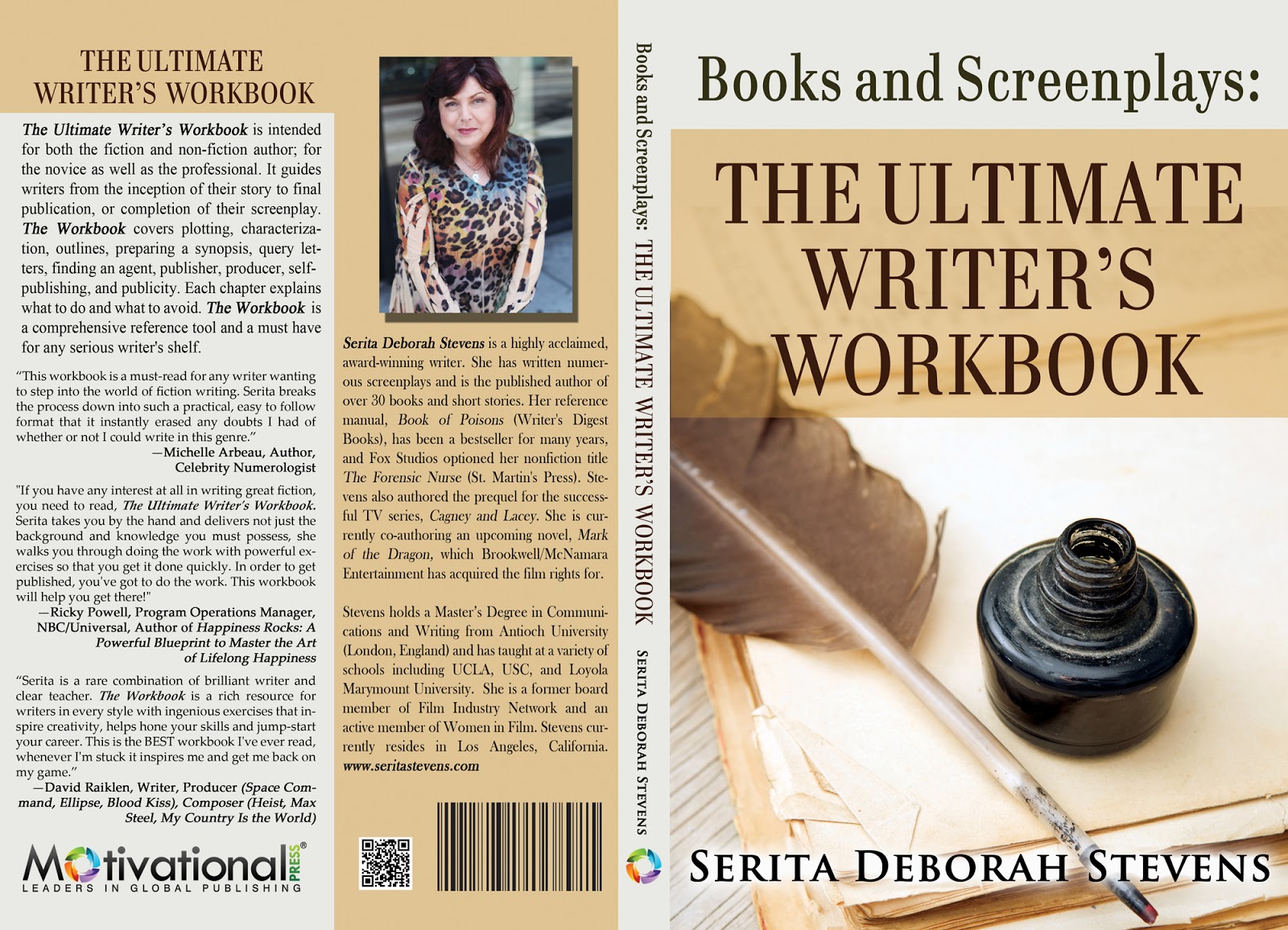
What a delight to have the prolific Serita Stevens back with us at Write Away. I hope you read her earlier post on script writing a couple of months ago. Not only will this post help all of us who struggle with those critical first pages, but she has two new books out this fall! And, of course, you must already own The Ultimate Writers Workbook for Books and Scripts.

"It was a dark and stormy night."  Those words have been made famous by many including the Peanuts dog, Snoopy. 
While it is a beginning to a story, you have to ask yourself "Is it the best beginning?"
Do you have a great first line - one that not only introduces your protagonist gives us a hint of what will happen?   Have you established the tone of your story?  If it will be comedic, you have to have comedy; if horror, there has to be a hint of scares.
Readers will stand at the bookstore counter and, after reading the back cover, will flip though the first few pages to see if it entices them before putting it back on the shelf.  Script readers will give you a few pages to prove your worth before they dump your script.  In fact, while the pervading myth is that they give you ten pages to hook them, after talking to a number of studio readers I have learned that the facts are they can usually tell from the first page or two if you are a professional writer and if they want to continue reading your script. 
Whether you are writing a book or a script, today's fast paced world demands that you keep the audience attention.  This means engaging them with the main character and his problem as soon as possible; it means engaging us on an emotional level.  After all, it is the universal emotions to which the reader relates and this helps the reader to bon with the character. 
The characters, especially the main character or your protagonist, needs to be introduced within the first two pages at the latest.  This is the person we will be following throughout the story.  It is he who will change and develop in the story.  It is he whom the audience identifies with. 
We don't need to know what color his hair or eyes are, we don't need to know how tall he is, though the type of clothes he is wearing can tell us something about him -pressed pants tell you one thing, while torn jeans and dirty tee-shirt tell you something else. It is the character's personality that we need to experience. 
What is the character's need, his want (which often is two different things,) and his flaw?  We need a hint within the first few pages.  What are his intentions, plans and outer goals?  The writer needs to give the reader a hint of the problem and an idea of how it will get worse.  The goals have to be visual and something that the reader can see and measure the progress by i.e. he will get to point x by the end of the week to rescue his wife or he will accumulate so much money so that he can ransom his daughter.  (This is the outer need, but you have to understand the character's inner need, as well, and that can be totally different.)
While one has to describe the location, to a point, and give the reader a sense of the world that our character inhabits, there is a limit as to the description you are going to give here.   If you get too lost in the narrative of the world, you will lose the reader.    One of the worst problems new writers have is being too descriptive.
Back story has to take a back seat.  (Often new writers tend to tell too much of the character back story and bore the reader.   Hint this in bits and pieces and don't do too much of it until page 50 (book) or Act 2. 
There has to be an incident or a catalyst that starts off the book or script.  This is the hook that pulls the reader into the story.  Is there a time clock started?  Is suspense going?  Is there dramatic irony - that is does the audience know something that the character does not?
The protagonist can be in the middle of something that perhaps has been going on for a while, but it needs to be something that establishes the conflict going on.  This event will showcase the character's humility, fear, need or dream.  It will give us a sense of the complication that he is facing and how he will grow and change.   
However, until we start to bond with the character and identify with him, we won't care if he wins or fails.  Establishing the emotional core from the beginning of your story is of the utmost importance.

So the first ten pages must -
·       Engage us on an emotional level
·       Establish your protagonist and his problem, goal and fears and how the problem will  get worse.
·       Hook the reader's attention with compelling conflict
·       Have strong, vivid characters
·       Establish location and tone
·       Format correctly - this is especially true if you are doing a script
·       Beware of too much exposition
·       Make sure you are starting your story in the right place without too much back story

Happy writing and keep reading. 


An established writer of mystery, crime, historical, thriller, western and young adult novels, as well as several produced and many optioned screenplays, Serita also teaches writing.  Her newest books include The Ultimate Writers Workbook For Books And Scripts - based on her teaching at USC. UCLA and other universities and Against Her Will, a teen drama based on her experiences as a psychiatric nurse. The script/book is now being considered by Lifetime.

Serita has two new books coming out from Oak Tree Press this fall. Heathen Heart is an historical romance about Boudicea's revolt against the Romans in 60 AD (to be released at the end of September), and Deceptive Desires, a female-driven western romantic suspense (released at the end of October).

She frequently lectures at both national and international writing conferences and mentors young writers.

Trained as a forensic nurse, she helps other writers with their medical and investigational questions.  One of her popular book is The Book of Poisons from Writer's Digest for writers to get their poisons correct when killing off their victims.  Recently, it was featured on a Law &Order!!

See more about her at www.seritastevens.com or reach her at sswriter400@gmail.com

Tuesday, May 12, 2015

Guest Post: "Create Your Own Source Material" by Serita Stevens

I am very happy to introduce to you the author of one of my favorite books, The Book of Poisons! Serita Stevens is well-published as a novelist, writing authority, and script writer. One of her books is up for consideration as a TV series! Watch for Red Sea, Dead Sea.
-->

Producers these days are looking for source material – books, articles, stories, plays or anything with other backing.  They like knowing that there is a fan base already established for the story they are buying.   So why not double your chances of a successful sale?
Each story has its own home; Its own best way of being told.  Some stories, however, can be told in more than one form.  To do this, however, takes knowledge and understanding of what the other forms need and how they are prepared.  Each form requires a different way of thinking and a slightly altered writing style.  You can do it, but it takes thought and time to learn.
As an established writer of both books and scripts, I do many book/film deals.  One may think it is only a matter of learning a different format, but it is truly more than that.  There are many similarities since a good story is, after all, a good story, but there are also differences.   
 Many hold the myth that writing scripts are easier.  I believe that is false.  It takes just as much work to write a compelling script as it does a fascinating book, but the techniques vary a bit.
Some of the things that are the same in books and scripts are this –
PLOTTING
No matter what you are writing, the work requires good structure- including inciting incidents, plot twists and dynamic scenes; well-drawn characters – both protagonists and antagonists - with their own goals, flaws and desires; and, of course, dynamic endings. 
CHARACTERIZATION
For all my stories – be they books or scripts – I do a complete character biography of ALL of my characters.  These people must be well-rounded and believable.   You must understand their journey and their arc.  This includes the secondary participants, as well, since they can often effect the plot, the theme or have their own subplot, which can promote the theme.   
Many new writers think that physical description is crucial to the character. It’s not.  It’s their attitude and what action that they are involved in that tells us about who they are.   Be sure to balance the good and bad aspects of the person. No one is all good and very few people are all evil.
OUTLINING
Outlining, may not be for everyone, but I find, is essential to make sure that I cover all the plot points and plant the twists and clues in the right places.  It helps me to keep the stakes high and focus on the genre I am writing.  It also helps me to do more than one project at a time as I can see what needs to be done on that story for that day.  It doesn't mean I stick like glue to the outline.  It does mean I use it as a guide.
THE FIRST PAGES
Beginnings, the first few pages, are crucial for both books and scripts.  Today, unlike in the past when the author could meander about history and setting, stories must start with action and jump into your characters.  We must be hooked immediately with the problem, situation, identify the setting, and get to know the main character, at the same time.   Not an easy task, but it can and, often, is done.
In neither case do you get the luxury of wandering around your setting. Back stories , if referred to here, must be only hinted at to give the reader a reason to want to continue reading.  Prologues can sometimes be used in books, and occasionally in scripts, to set the tone, but should be used sparingly. 
TITLES
Titles are another bugaboo for many writers.  Your title must give a hint about the genre and the story.  While titles are not copyrightable,  it is a good idea to research your title and see other stories with your same title as you do not want to be identified with a story that did not do well.  One of my stories, now being done as a script, The Unborn, has been used as a title for many films and books and in order to make mine more unique, I changed it to Unborn Witness. 
UNDERSTANDING ONE’S AUDIENCE
The writer must understand their audience. Who are they writing for?  Don’t say that your story is for everyone because very few stories are.  It’s naïve to think that all will like your work.  Are you doing a chick-flick?  A mystery? An action or thriller?  Is it something that young men will like more than women?  It is something for the older viewer?  Understand who the reader is and write for them. 
PROOF READING
Grammar and spelling must be checked no matter what you are writing.   We are writers and there is no excuse for doing this poorly.  I often write my first draft quickly and miss things but it's important to go over what you have done.  I find that even after re-reading my material several times, mistakes can be found and I have an outside reader to go over my material before I hand it in. 

There are, however, many differences between writing scripts and writing books.   
NOTES
Script writing, even more so than book writing, is a team effort.  As a novelist, it is easier to write alone in Iowa.  You might get notes from your agent and/or the editor, but you are more autonomous as writer.  Whereas being a scriptwriter, you will find notes come not only from the producer, studio, director, actor, and others.  You must understand that the script is a blueprint for a movie.  You must understand that not everything you write is gold and if you cannot accept notes and be willing to change, you will not get very far.   There is an art to listening and accepting notes. 
FORMAT
While it looks like format is the main difference between scripts and books, this is just the tip of the iceberg.   As for formatting, I like Movie Magic the best because they do not charge for tech support as Final Draft does.  No matter which program you use, understand things like the use of parentheticals, slug lines, etc.   Read produced scripts to see what the format is and don’t have numbering or camera angles on your spec script as that marks you as a novice. 
PAGE COUNT
Length is one big thing.  While a book can be as long as your publisher will allow it and most books are a minimum of 300 typed pages or much longer, a script can be only 90 to 100 pages. (120 used to be accepted, but lately, a shorter page account has come to be expected.) Should you turn in a script longer than 120, you will, especially if you are an unknown writer, have difficulty getting read no matter how protest at the merit of your story. 
APPEARANCE
White space is crucial.  The overwhelmed reader will often flip through the pages.  If the pages are too dense with narrative, they might just put your script down. 
POV
Point of view in the script is far more focused than a book.  While in books you can alternate POV and tell parts of the story from other characters and even go off onto subplot tangents, the script should be mainly from the main character and that protagonist should be active in solving their own problem.   It is said that the main character should appear in, or be part of 80% of the scenes. 
NARRATIVE
Writing short sentences creates suspense in books, but even more so in scripts.  Less is more here.  Be succinct in your writing.  While in books you do not want huge unbroken descriptive passages, narrative in scripts should be, if you can help it, no more than five lines.   The white space actually pushes the reader forward where as the longer paragraphs slow them down.   
When writing your book, you must consider and explore all your senses. What is the character feeling, seeing, smelling, hearing, sensing, etc?  In scripts, you are limited to the visual.  In both, specifics are important, but even more so in scripts.  Leave the script’s stage dressing to the designers. 
DIALOGUE
While books can have more on-the-nose dialogue, subtext is crucial in the script.  No more than five lines of dialogue.  Think of the poor actor trying to memorize all you have written when you have a huge monologue.   Try reading it out loud, yourself.  If you must have a dialogue longer than five lines, try breaking it up with an action line. 
VISUALIZATON
Books will allow you to get into your character’s head and talk about their feelings and hear their thoughts.  Not so in scripts.  Everything, and I mean everything, must be visual.  If you say that the character is angry, how do we know, what do we see? 
BUDGET
Especially if you are a fairly new writer, if you want your script to be produced, you have to keep the budget in mind.  The fewer the characters, the less it will cost.  When doing an adaptation of a book, I often find that I have to combine excess characters.   Think about the locations you have, cast of thousands, car chases, uses of animals and use of children.  It’s okay to write them if you only want to have this as a reading sample, or if it really is crucial to the story, but keep it to a minimum. 
PAYMENT
Another myth is that the book writer is paid handsomely for their rights.  This, alas, is often false.  Since the production company, often before they sell the story, must pay to have the script written, will hire another writer to expand and focus the story into what is needed for a script. 
The book writer - who in today's publishing world might be lucky to get a small advance from the publisher, sometimes must kiss their stories goodbye and let the A-list script writers to do what they will do.  That doesn’t mean you, the book writer, can’t do a first draft of the script.  It does mean that you will be, if you are lucky, partnered with an established scriptwriter that the studio or production company feels more confidence in. 
Books turned into film are often vastly different from the printed word for a variety of reasons.
As I said, it is possible to do both, but you need to be aware of the limitations of each and what is required of each format.   It might take you longer to write the book because you have to write more words, but the script requires just as much prep time in characterization, plotting and research as the book does. 
Good luck.


-->
An established writer of mystery, crime, historical, thriller, western and young adult novels, as well as several produced and many optioned screenplays, Serita also teaches writing.  Her newest books include The Ultimate Writers Workbook For Books And Scripts - based on her teaching at USC. UCLA and other universities and Against Her Will, a teen drama based on her experiences as a psychiatric nurse. The script/book is now being considered by Lifetime.
She frequently lectures at both national and international writing conferences and mentors young writers. 

Trained as a forensic nurse, she helps other writers with their medical and investigational questions.  One of her popular book is The Book of Poisons from Writer's Digest for writers to get their poisons correct when killing off their victims.  Recently, it was featured on a Law &Order!!
See more about her at www.seritastevens.com or reach her at sswriter400@gmail.com